Patched! ‘I'm addicted to buying clothes - please help’
The Patched advice column is back for 2026 with advice about how to break free from fashion addiction

Hello and welcome to Patched in 2026!
In between my regular newsletter I send out Patched - a series where people ask me a fashion (or fashion-adjacent) question, and I reply with a short letter from an anti-capitalist perspective.
If you have a question, please email me at: DearPatched@proton.me
The title Patched is a reminder that at this critical time we need repair and regeneration as well as analysis. I will keep unpicking and unravelling the fashion industry but Patched makes space to explore mending - finding solutions to both personal and structural problems.
If you like Patched please forward this email, share it as a post or screenshot - these posts are now unlocked so you can share away. If you've been forwarded this and want to keep in touch please subscribe for free.
Want to listen instead? For the first time, Patched is available as a video:
Dear Patched,
I’m ADDICTED to BUYING clothes – please HELP.
I could leave it there as that’s basically the whole letter but if you want/need more – I really feel like this is ‘an addiction’, though I feel lousy using the word addiction as I’m talking about clothes.
I wanted 2026 to be different. I wanted Christmas to be a line after which I stopped – I had a NYE outfit, who needs clothes for January other than a giant coat and a couple of scarves, I know I do not need any more clothes.
But I’m only a few days into 2026 and I feel overwhelmed – the 2026 trend videos have started and I am watching them, I am envious of people’s stuff I see online (and when I go for a walk), I’m distracted and my fingers are itching to go online and buy stuff.
Please can you help me figure this out.
Also the world is also scaring the shit out of me (which is not an excuse as I shop when nothing is going on as well) but it is not helping.
Thank you. Anon.
Dear Anon,
Thank you for your letter and for your honesty.
If you look at a greetings card display in the UK it will be filled with ‘Wine-o’clock’ and ‘Mummy’s survival juice’ cards which normalise alcohol as a coping mechanism. Similarly to alcohol, consumption gets trivialised by society (see the hundreds of cards featuring shoes and cars) and being a ‘shopaholic’ is dismissed as a joke. But as your letter outlines, feeling compelled to shop is not trivial or pleasurable.
I appreciate your discomfort with using the word addiction when it comes to shopping. It is worth knowing that there is a recognised condition known as oniomania – which is the obsessive urge to buy things. I will say up front that anyone who recognises this condition in themselves might want to speak with a doctor or find a qualified therapist who can help with addiction.
I am therefore going to use the word compulsion instead of addiction because this column is friendly advice not therapeutic help.
One thing that needs to be crystal clear is that being compelled to shop is not a personal failing.
It does not make you weak or bad. It does not mean you don’t care about garment workers, waste pickers or the planet. Fashion is a trillion dollar industry that pours billions of dollars into psychologists, creatives and tech workers trained in behaviour modification, it is not your fault that you feel overwhelmed.
The fashion industry works relentlessly to drag you into shops and websites, to keep you permanently dissatisfied and on edge, to bombard your brain with the message that the beautiful things you already have are not beautiful any more and that you are wrong and stupid for thinking that they are.
A key tragedy of the fashion industry is that it purposefully makes us use clothes for the wrong thing. We have lost the 'use value' of clothing and had it replaced by the endless discontent of ‘fashion’.
So how do we get out? Habits. Goals. Questions.
Habits
Having habits is a key part of what makes us human – habits are automatic behaviours that we don’t think much about. Some habits are good for us – like locking the front door or staying hydrated. Some habits, however, are unhelpful.
It’s important to recognise that fashion is designed to be habit forming – the habit of adding to your wardrobe used to be seasonal, now we are pushed to shop every single day. The act of buying clothing can become associated with a positive effect – a little rush of hope for the future for example.
Because that rush of hope is what we are looking for (especially given the state of geopolitics) we do the action that gave us that feeling again. And again. And again.
Then because we are doing it a lot, we start to get prompted to do it by outside factors – for example getting on the bus becomes associated with reaching for our phone to scroll through Instagram. Talking a walk at lunch becomes associated with visiting a particular shop. The smell of dinner becomes associated with shopping on Depop.
When we try to step away from a habit we can get what you described as itchy fingers – the world we are in becomes secondary to the craving to do the habit.
If you read up on habits as associated with compulsions, you will find lots of good advice on replacing old habits with new ones – it is not enough to just stop the old habit, you need to fill the gap with something more interesting.
I don’t know when the habit of shopping strikes for you but start to notice it and recognise that there are any number of exciting and positive things you can do instead. First up – join a fashion activist group and change the system! In addition, sketching, reading, films, walks, sports clubs, sociable dinners out or in, crafting, phone calls, volunteering, gardening...if you are a nerd like me you can actually get dopamine by learning and pondering new things.
Write down how you are feeling when you feel most compelled. Is there a pattern with your hormones, is it after watching the news, is it after watching YouTube or going on Instagram, does someone in your life make you feel inadequate? If there are patterns, take steps to deal with what is underneath the compulsion. For example, definitely stay away from triggers – if YouTube is making you feel discontent or itchy, then unsubscribe from those channels and delete YouTube if needed.
The great news is that the brain is adaptive and neuroplasticity is your friend. You can form new habits. Don’t hesitate to get support if you need it – from peers, websites or professionals.
Goals
Part of new habits is setting realistic goals – decide what it is you want and write it down. You hinted at wanting to stop shopping altogether but maybe ‘never buying any clothes ever again’ sounds too scary, so set a goal that is healthy and realistic – ‘one purchase a month’ to start with? Do not, however, beat yourself up if you do not make your goal.
You can also add in positive goals that make you feel good like: ‘I will mend all my clothes and shoes that need a little TLC’, ‘I will learn to knit’, ‘I will spend a day putting outfits together from what I already have’, ‘I will put all my saved fashion money in a pot and send it to Palestinian families at the end of the month’, ‘I will watch Wes Anderson’s entire back catalogue over the winter with my phone in a different room.’ [These last two are from my personal list.]
Questions:
You can also interrupt the urge to shop by stopping to ask yourself questions.
1) Who actually wants this?
When the familiar narrative of ‘I want that’ starts up in your head, can you take a moment to think about who the author of that ‘want’ actually is? What I mean is can you bring capitalism into focus – can you take a moment to remember the sheer amount of corporate power being focused on your brain and that you might want to stick two fingers up at the tech bros and disobey? Ultimately it is capitalism that wants this, not you. Disobeying and then using that time and space for something you choose is its own cheeky thrill. Rebel – Because You’re Worth It!
2) Who am I really giving money to?
Similarly, the ultimate answer to who wants this is: The billionaire who owns the brand you are shopping from – for example the repulsive characters of Amancio Ortega who owns Zara and Bezos over at Amazon. These guys do not need any more money and will do more terrible things to people and planet if you give it to them. Dig into the corporations behind the clothes and see if that can turn you off buying from them. (This is not a free pass for buying second-hand or from ‘ethical brands’.)
3) Do I have this already?
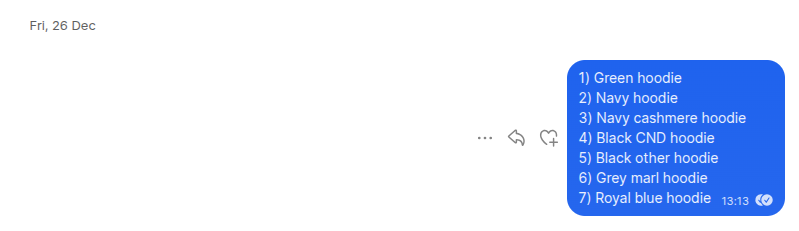
We repeat buy – it’s a fact. This Christmas, an article on a fashion website made me think I wanted a new hoodie. I knew this was a mid-winter impulse so I got myself to write down a list of all the hoodies I already own. When confronted with the facts in writing I did not buy a new hoodie. You can take this further and expand into positive memories of the things you have to reconnect with them.
The fashion industry is designed to be deeply compelling – to manipulate us into ignoring the wonder of what we have, into forgetting the stunning beauty of the planet we live on, into losing our place as active human beings who can move and dance and laugh and fight for what we truly want and need.
Remember that it is neither your fault nor hopeless. You can take steps to build new habits and a more fulfilling world for yourself and those around you.
Sending solidarity, Tansy.
p.s. Recommended in London: In the spirit of being offline, I've visited two exhibitions this year: The Lee Miller exhibition at Tate Britain (half fashion photography, half harrowing war reportage) & the Wes Anderson archive at the Design Museum (light-hearted fun).
p.p.s. I made two videos at the Venezuela protest outside Downing Street. Peace Not War: